PAID TO WANDER


Monday, February 3, 2014

Exploring the Past by Illustrating in the Present

One of my many obsessions is an insatiable curiosity about ancestral pueblo archaeology. My first visit to Mesa Verde National Park when I was 12 initiated a still-present admiration for these people, how they lived and the astounding beauty of their homelands. I was raised on TV and movie Indians who spoke in halting guttural awkwardness and rode horses to attack settlers circled in their wagons sending arrows and spears into their midst while being shot off said horses. Not very smart "savages"!
But here were a people that were farmers, built elegant masonry villages and worshiped from subterranean holy chambers.
This spurred my continuing studies of these people and soon led me to the premiere cultural nexus centered around Chaco Canyon in northern New Mexico that started around 800 A.D. What fascinates me about the Chaco phenomenon (as it is known by some) is that this super civilization erupted overnight and into a sophistication that then deteriorated over several generations. The elegance of the super villages they created were unprecedented in the Southwest - and they were masterfully planned - symmetrically and astronomically oriented super-villages that made earlier prototypes seem awkward and rare.
When you get a chance to wander around these ruins today, one is struck by the immensity of the pueblos and the thousands of hours to work the sandstone and to haul in thousands of massive timbers, some from over 50 miles away.
I was instilled with the burning desire to be able to see these structures in their prime, with gleaming fresh stucco and crowded with the people.
After a trip to Chaco and pushing miles on foot into one of a dozen of the Super Pueblos or Great Houses as most say, I decided to "rebuild" a village to help myself and others to see how it must have looked to witness such a remarkable sight- a shining city floating above the desert washes.
I was drawn to the structure known as Penasco Blanco (Spanish for white rock, referring to the pale sandstone that caps the mesas in this canyon) unique in that has an elliptical configuration with not one square corner on its exterior walls found in all the other villages. It was one of the original core towns when the canyon was pioneered in the 8th century.
Penasco is at the west end of "Downtown Chaco" and was the portal city for the western edge of "main street" for the people entering or leaving the outlying vastness of the cultural province the Chacoans created.
For more information about the fascinating Chaco phenomenon please visit the National Park Service site for this World Heritage site. Chaco Canyon National Historical Park

Around 1999, I decided to do a rendering of Penasco as a response to the abundance of imagery and obsession by many concerning Pueblo Bonito, the "darling" of Chaco Canyon. Bonito was the largest and possesses a singular presence of grace in design. But I wanted to feature something that had not already been done.


This is an aerial photo of Penasco Blanco Ruin in present day. The round depressions are Great Kivas and the faint line on the right is an ancient roadway.


Some remnant standing walls to this once 5-story structure. This is the approach from the canyon below. 

A wall fragment showing the skilled masonry of the Chacoans. The walls were covered with stucco, thus veiling the structural beauty.


This is the view and elevation that I based my restoration on. This vantage point has a stone shrine structure nearby.


I found this floor plan and used it as reference
.


This is a study I did to get an idea of structure and lighting.
From the reference material I composed and completed the painting below. Of course the accuracy of the building details is speculation. Some folks think that the Chacoans completed room blocks with fully filled out spaces and elevations creating smooth cube shapes. I chose to show the reenactment to display that although there was definitely a master plan, some segments were complete while others were in progress. I also indicated some sections falling into disrepair.
This massive building was created over many generations and expanded in leaps and bounds. Great Houses in Chaco Canyon started out with open plazas but were soon partially and then eventually completely enclosed with room blocks.
I chose to pick the time when the plaza entry had been reduced to one central gateway, around 1125 A.D. Soon after even this was sealed off and entry to the pueblo was only by ladders that had to be lowered from above. Trouble seemed to have arrived at the canyon.
"Penasco Blanco" oil on linen  32" x 44"
 
 
I also took liberties with the topography to augment the feeling of Penasco hovering over the fields below.
I hope you enjoyed sharing in my proclivity- and that you managed to read this far!

Monday, July 22, 2013

Santa Fe Plein Air

" When setting a scenery, the tableau, if placed in the country side, should be abundant with animals to suggest well being. One should also populate the yarde with powltry as well. This will enliven the display and attract the Patron." - 'Treatise on Content and Composition' by the Compte de Roget, 1745.


I recently took an adventure trip to Santa Fe, New Mexico. I went there to participate in a plein air event sponsored by the Plein Air Painters of New Mexico.

The event featured a week of painting on-site in and around Santa Fe and culminated in a show at the Gary Kim Gallery. At this posting you can still view the show digitally by going to the Gary Kim Gallery website.

What I value about well-planned plein air events is that they promote and acquaint artists to key scenic areas in the regions in which they are held. I found out that even in places that I thought I knew well I was directed to some scenic spots that I didn't even know about.

I had been visiting Santa Fe for decades and was pleasantly surprised to find intriguingly beautiful vistas unknown or overlooked before.

These group events also present many opportunities to paint with and collaborate with a variety of other artists. Although I do not consciously study other painters' techniques there is always an osmosis that occurs when painting with others. I also consider it a sort of cross- pollination. Whether it is through observation or critique I am always surprised and pleased when new insights and inspiration emanate from these associations.
 
I was graciously invited to stay with my friend and artist Roger Williams and his great setup on the outskirts of Santa Fe. He has a great house, great view, attached studio and greenhouse. All the comforts any freeloader could hope for!
 
Roger was able to come out and play.
We had great times acting goofy and painting on location. I picked up a lot from Roger during my visit. I am a visceral painter and often end up with subconscious visual traps such as repetitive shapes and annoying linear aberrations. Roger is more analytical and his discerning eye helped repeatedly in my paintings. He reminds me that although the trip may be exciting, it also has to make sense.


Here are a few selected pieces (survivors) from the Santa Fe trip.

"Cienega Morning" oil on linen 9x12
We painted this in the early morning from Louisa W. Martinez's veranda. La Cienega is west of Santa Fe and I found it a very enticing area. This is an area of juniper- studded arroyo hills above green laced river bottoms. This piece offered an opportunity to paint the intriguing dry hillsides with early morning tree shadows.
" El Zaguan Garden"  oil on linen  12 x 9
I had wandered by these enchanting grounds along Canon Road for many years and never new the story behind it - or had the opportunity to wander around and paint it.


" Cienega Hills" 9 x 12
This was my first painting on the trip and was a " find" while motoring aimlessly about on the back roads. A local realtor stopped to admire my work- and to try and sell me the house that is opposite this view. I offered a straight trade for my car- he declined the offer.
" Ranchos from Under the Cottonwood" 9 x 12
I explored Ranchos De Las Golondrinas on a very hot afternoon and found this view of the old walled compound from under an ancient and shady cottonwood. I brought the piece back to Roger's and thought it lacked something. I mentioned that the latia fenced structure was a chicken coop- so we decided that a fowl or two would spice up the scene (see quote at the beginning). I put several birds in the piece but because of the small scale I felt the one rooster was sufficient and took the others out.

Lots more to paint in Santa Fe!


Friday, May 3, 2013

The Governor's Art Show and Sale--- Small Town- Big Art Center

" Acequia Reflections" 16x12 oil on linen
I just returned from the opening reception at the Governor’s Invitational Art Show and Sale that will be open daily until June 2 at the Loveland Art Museum in Loveland, Colorado. After 21 years this show has tapped me to be in it for its 22nd show.
To paraphrase Groucho Marx I am not sure I want to be in a show that would let me in it! I am
joking. Click to go to the Governor's Show site
The paintings on this post are all in the show. The one above sold at the reception.


" South Clear Creek Falls" 20x16 oil on linen

I am very appreciative to be accepted into this nationally renowned exhibition. It is sponsored by the Rotary Clubs of Loveland and the Thompson Valley.
Many of the beneficiaries of the success of this Art Show and Sale are children and youth in the community and beyond.  Every 3rd
Grader in the Thompson School District gets a hard-bound dictionary. 
Several thousands of dollars are given to college bound students  and an apprenticeship for a non-college bound student is arranged.  The Kids Pak program feeds hungry kids each weekend for the entire school year.  A Books for Kids campaign and other youth organizations are helped, as well as some international projects.  And, of course, both clubs are extremely active in participating in Rotary International’s End Polio Now campaign. 


" Threshold to Loch Vale" 24x32 oil on linen

This show has been a standard for promoting the finest painters and sculptors in Colorado and has presented some of my favorite painters such as Richard Schmidt, Stephen Quiller, and Charles Ewing.
A side story on the Loveland art scene illustrates the power of individuals to shape communities and events.
My family was intimate with Loveland when I was a kid, before the art aspect was developed. It was a small agriculturally-based community and was and is a tourist gateway to Rocky Mountain National Park. A favorite trip for us was to motor up to Trail Ridge road and feed the chipmunks (not cool, now).
My aunt and uncle lived there with their two daughters/ cousins and we would visit them several times a year.
I attended Colorado State University in Fort Collins so I dropped in on them occasionally when I was going to school. By the time I graduated in 1975, Loveland was growing rapidly as was all the Front Range but still had not become the art scene it is now.


"Pass Dam" 12x16 oil on linen

That changed when sculptor George Lundeen set up a studio in 1973 followed soon by a foundry. He was the cloud seed that soon started the creative rain for this little burg. Other sculptors and artists quickly migrated to this art friendly environment.Shortly after Lundeen’s arrival, a sculpture show was created that soon became a national renowned annual showcase. There are now two world class sculpture shows annually.
Fine art galleries opened and public sculptures started popping up like mushrooms. 
Part of this creative upwelling  was also the aforementioned Governor’s Show.
Click here for a link to Loveland
Today Loveland is one of the most renowned small town art centers in the U.S.
To me it illustrates the power of a few individuals with vision- a process that can happen in any community- maybe even yours.


Sunday, February 17, 2013

Bitter Winter? Hunker Down in the Studio

Firstly- what is hunker? and how did it get into our language- Perhaps a topic for another blog.( I have already checked out its derivation.) And I am pretty sure you have to use it with "down" and not just by itself. As in- I am going to hunker?
Doesn't sound right.
Us ol'timers in this place called the San Luis Valley were reminded this past couple months of how "challenging" the winters used to be. We have been lulled into a mild decade or so of relatively not-so-frigid winters.
But starting mid-December we were subjected to some particularly bitter temperatues. We set at least 16 national lows for the lower 48 running into January. One reading in the wee hours logged in at a minus 32 F!
And yes you should be envious of our collective fortitude to withstand such extreme cold!
These conditions encouraged me to recollect the warmer and greener times of the summer of 2012.
Especially some of the amazing environs around Estes Park and Rocky Mountain National Park.
So in the studio I have been working up some pieces from a hike that we took up to Loch Vale, one of the most picturesque vistas in all of the park.
Fellow artists Coni Grant, Sue McCullough and Dawn Normali set out in August with plein air gear and took the 3.5 mile trail into the lake.

I also brought up one of my recorders to play music at the lake. I was rusty and the wind off of the lake messed with the notes- but it makes for a great picture- huh.


I was able to get a pretty good start on that painting and touched it up later in the studio.


Below is the finished 12" x 9" oil entitled " The Loch"


Here we are in the act, me, Sue and Dawn (photo by Coni Grant).

When I was confined by the frigid temps this winter I decided to work up a larger painting from another view on the edge of this magnificent lake.

Below is " Threshhold to Loch Vale" and it is 24" by 30."


Some of our snow is melting now but there are still large drifts lurking in the north shadows.
Winter is still holding firm but soon we will be out in the field again- time for some spring thaw pieces.


Monday, November 26, 2012

Art for the Endangered Landscape


I am proud to announce and promote a project called Art for the Endangered Landscape along with the San Luis Valley Ecosystem Council, a grass- roots organization I helped organize 15 years ago as a founding board member.
The crux of the program is to combine art with conservation- definitely not a new idea by any means.
This initial offering is centered around an area in the foothills of the San Juan Mountains in southern Colorado. South of Del Norte along San Francisco Creek an enterprising company based in Texas decided to try to drill an exploratory oil well in the middle of a rural residential area.

The sordid details can be better explored by reading at the San Luis ValleyEcosystem Council website.

We organized a two part event. The first has already occurred which was a paint out day in September. 20 artists gathered and spent the morning taking in the local vistas and starting works.

The second part is an exhibition and sale that features the artwork inspired by the day. The opening of this show will be on Friday, November 30 from 4 to 7 pm at the Adams State University Community Partnerships Gallery and will run until December 20.

For more details on this project I refer you again to the SLV Ecosystem Council’s page on that.

The proceeds from the show will benefit the Council in its vital work in protecting, enhancing and restoring our public lands in the San Luis Valley.

So that’s the bare bones news part.
Below is the plein air piece that I have donated to the SLV Ecosystem council. The drill site will occupy this vista in the lower left center.

"San Francisco Creek Morning" 12 x 16 oil on linen

I want to wander a little bit into the tricky terrain of the land of the Muses.

So what inspires the artist and points them in directions of possibilities?

My formal art education has been extensive. Steeped in intellectual concepts of the classical elements such as composition, line quality and color theory.

I have also honed my sensibilities when I paint to include the energetic resonance to the life force and to imbue some of that into my art. For a more complete explanation you can go to my web page- called Shamanic Luminism.

Many others allude to reverence for our natural systems in their art- mostly in magazines that are geared towards art collectors. Artists espouse how they love nature and try to convey that in their art- that feeling- the emotional content that is usually alluded to by the intellectual approach to art as “brushwork”, or “spatter”-  things that show the result of sentiment and emotion but not the content of that emotion.

Through many associations with landscapes artists, I am sure that many are tuned into intense spiritual communication with the land and its creatures. In some ways the act of painting may be an excuse just to get out into it.
It is about time that reverance for nature be given an equal place at the art discussion table as in " I applaud your use of contrasting tones in this passage here- and you really resonated  the primal rock energy of that butte!"

Monday, August 6, 2012

The Rebounding High Country

Timberline Spring    9x12
Recent plein air excursions this summer have brought invigorating subject matter - the high country of the mountains with glacial lakes and fresh streams. The usual suspects have been my cohorts, Sue McCullough and Coni Grant. Recently we have been joined by Karen Bonnie, a talented painter living outside of Del Norte.
Due to our busy schedules we usually try to go out once a week and knock out a morning painting- or often the painting knocks us out - ha! rimshot!  A morning session usually affords the afternoon for other activities- like trying to fix the morning painting.
So to get into the high country from our lowland residences requires something close to us and relatively quick to drive to. This requires black top and then good gravel roads. This led us to the well- roaded uplands of what used to be the timber country in the San Juan Mountains. These are the very places I avoided with disdain in my younger years. This disdain became a point of contemplation for me and has led me to some reminiscing about my earlier perceptions.
As a " for instance" this picture is a pretty dynamic scene but is deceptive. It was taken from the edge of an old logging road. The forest in the foreground and all around where the picture was taken were extensively logged probably 30 years ago.
Likewise this picture, also taken from a decades-old timber road. Timber cuts are all around.

This part of the San Juan Mountains lent itself to intense logging because of its gentle topography making it a prime target for timber companies in the 60's and 70's when these forests were cut- heavily.
When I started in forest land conservation efforts, places like these were in full production and of little interest to those of us seeking to preserve the virgin lands that were still around- but threatened by impending dozers and chain saws. Our focus was on areas that were remote and more challenging- and were still wilderness because all of the easiest terrains with the biggest trees had already been cut or were about to be. Even so, the timber machine was big back then and the Rio Grande National Forest was in the tree cutting business big time. Their opposition to land preservation was well- funded and formidible. In spite of this and due to public support, we were still able to preserve large acreages.
The hardest parcels to protect were those areas that still had big trees; Engelmann spruce is still the prefered milling tree for this region. They grow straight and tall and run up to the very limits of trees at the timberline. Their habitat is covered in snow most of the year and the growing season short. The prize trees were at least 200 years old. Although the forest service and timber companies tried to convince everyone that they were practicing sustainable harvest techniques, there were no word-dances that could gloss over the fact that they were in fact "mining" trees.
My recent wanderings in these cut-over areas has acquainted me with some amazing tree stumps of once behemoth spruces the likes of which will never be seen again for generations.
Ironically, the threat to many remaining big spruces in these mountains is not the chain-saw but the spruce bark beetle.
But I digress.

We were able to garner public support and through bipartisan legislation (yes- at one time this was actually possible!) many pristine areas were brought into protection as wilderness. And the timber industry still managed to flourish- for a time.
Hard to imagine that now- the biggest sawmill in the region is now a vacant lot in South Fork. The mill failed when cheaper southern US and foreign tree markets opened up and not because of those nasty environmentalists as was the common lament.

 I am revisiting areas that were of little interest to me back then but am now discovering pockets of splendid beauty - vignettes that are engaging if your eye does not wander too far.
I am also seeing the slow regeneration of these forests. Saplings sprouting amongst the stumps and the once younger trees now entering tree adulthood.
What I will not see are the big trees again in my lifetime.

Tuesday, May 15, 2012

The Pulse of the Land


Travel is a great tool to observe new and different places while allowing perspective about your home base.
Our recent trip to the Tampa Bay area was not our first but this time I had some huge insights into what it means when you say that there is a pulse of the land. That in itself implies a living, breathing being- and rightly so.
Our home is at 7500 feet above sea level and is laid out in a broad plain between two mountain ranges. We receive 10 inches of moisture a year- if we are lucky. The surrounding mountains intercept most of the moisture as it blows into us. On the valley floor the waters trickle into us from the highlands and creates an oasis/desert environment with wetlands, irrigated fields and a meandering river.
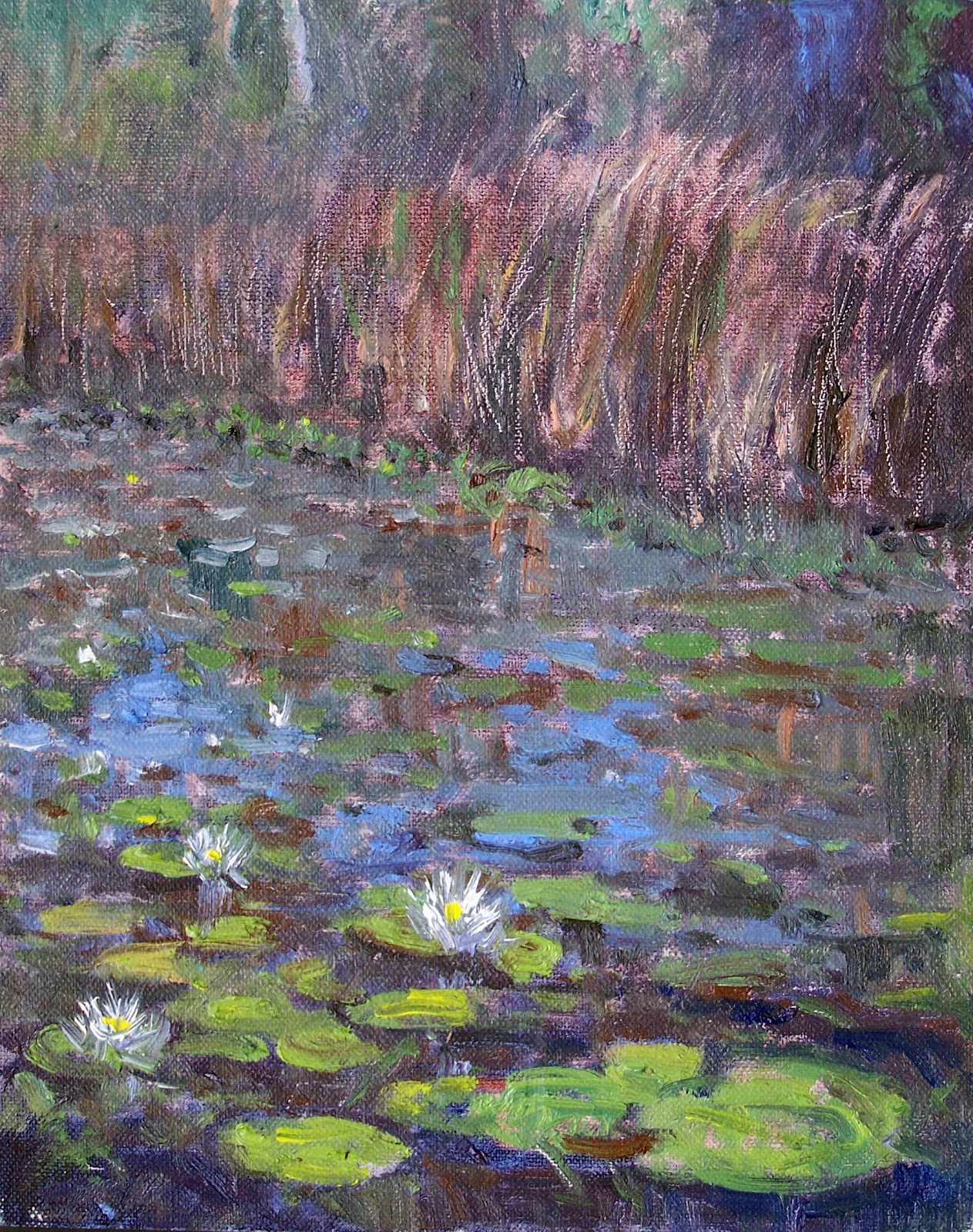
 Florida has seasonal dry spells but for the most part is in great supply of rain. Combined with lower latitude heat and sea level humidity this part of the country is a giant petri dish of biological potential. Bring it and it will grow- whether that means exotic plants or foreign animals. Many mundane species have turned out to be bullies unfettered by restraint found in their source habitats. One plant species that had become a nuisance is the water lily- a familiar theme of one of my painting heroes Claude Monet.
I was able to paint them, however, because even with aggressive herbicide spray they still persist to thrive- as in the lake behind my mother-in-laws house.
The pulse of Florida throbs with the theme of the abundance of life force. Especially the plants and animals associated with the wetlands such as fish, birds and a very major pulse of reptilian and amphibian sorts. The king of this swampy jungle is of course the alligator.
Seething, slimy, wet and noisy abundance from this most primitive of four legged- the amphibians and reptiles. The prolific bird life also adds to the cacophony of noise, embellishing the tapestry of sound spilling out of the waters.

"Dock Lilies" 10x8 oil on linen

When night falls the light fades and although the noises lessen, they persist til dawn. One evening I went out to the floating dock with a powerful flashlight to see what eyeball retinas I could detect. As far as I could see around the edges of the lake were pairs of eyes shining back at me. Some small and close together, others large and far apart and a smattering of varieties in between. An astounding number of eyes- staring at me.
The contrast between Florida and the Rocky Mountains is pretty big. I realized that the theme for the high mountainous part of the world was more about the land itself. Much more active geologically than the coastal lowlands but without the abundance or pure volume of biology that the jungle fosters.
Here the pulse is more about the mountain faces, protruding formations, colorful rocks and the ever present blue skies.
The pulse here is from the very skin of the earth itself.

Great Blue Heron


"Long Pond" 12x9 oil on linen