PAID TO WANDER


Monday, August 6, 2012

The Rebounding High Country

Timberline Spring    9x12
Recent plein air excursions this summer have brought invigorating subject matter - the high country of the mountains with glacial lakes and fresh streams. The usual suspects have been my cohorts, Sue McCullough and Coni Grant. Recently we have been joined by Karen Bonnie, a talented painter living outside of Del Norte.
Due to our busy schedules we usually try to go out once a week and knock out a morning painting- or often the painting knocks us out - ha! rimshot!  A morning session usually affords the afternoon for other activities- like trying to fix the morning painting.
So to get into the high country from our lowland residences requires something close to us and relatively quick to drive to. This requires black top and then good gravel roads. This led us to the well- roaded uplands of what used to be the timber country in the San Juan Mountains. These are the very places I avoided with disdain in my younger years. This disdain became a point of contemplation for me and has led me to some reminiscing about my earlier perceptions.
As a " for instance" this picture is a pretty dynamic scene but is deceptive. It was taken from the edge of an old logging road. The forest in the foreground and all around where the picture was taken were extensively logged probably 30 years ago.
Likewise this picture, also taken from a decades-old timber road. Timber cuts are all around.

This part of the San Juan Mountains lent itself to intense logging because of its gentle topography making it a prime target for timber companies in the 60's and 70's when these forests were cut- heavily.
When I started in forest land conservation efforts, places like these were in full production and of little interest to those of us seeking to preserve the virgin lands that were still around- but threatened by impending dozers and chain saws. Our focus was on areas that were remote and more challenging- and were still wilderness because all of the easiest terrains with the biggest trees had already been cut or were about to be. Even so, the timber machine was big back then and the Rio Grande National Forest was in the tree cutting business big time. Their opposition to land preservation was well- funded and formidible. In spite of this and due to public support, we were still able to preserve large acreages.
The hardest parcels to protect were those areas that still had big trees; Engelmann spruce is still the prefered milling tree for this region. They grow straight and tall and run up to the very limits of trees at the timberline. Their habitat is covered in snow most of the year and the growing season short. The prize trees were at least 200 years old. Although the forest service and timber companies tried to convince everyone that they were practicing sustainable harvest techniques, there were no word-dances that could gloss over the fact that they were in fact "mining" trees.
My recent wanderings in these cut-over areas has acquainted me with some amazing tree stumps of once behemoth spruces the likes of which will never be seen again for generations.
Ironically, the threat to many remaining big spruces in these mountains is not the chain-saw but the spruce bark beetle.
But I digress.

We were able to garner public support and through bipartisan legislation (yes- at one time this was actually possible!) many pristine areas were brought into protection as wilderness. And the timber industry still managed to flourish- for a time.
Hard to imagine that now- the biggest sawmill in the region is now a vacant lot in South Fork. The mill failed when cheaper southern US and foreign tree markets opened up and not because of those nasty environmentalists as was the common lament.

 I am revisiting areas that were of little interest to me back then but am now discovering pockets of splendid beauty - vignettes that are engaging if your eye does not wander too far.
I am also seeing the slow regeneration of these forests. Saplings sprouting amongst the stumps and the once younger trees now entering tree adulthood.
What I will not see are the big trees again in my lifetime.

Tuesday, May 15, 2012

The Pulse of the Land


Travel is a great tool to observe new and different places while allowing perspective about your home base.
Our recent trip to the Tampa Bay area was not our first but this time I had some huge insights into what it means when you say that there is a pulse of the land. That in itself implies a living, breathing being- and rightly so.
Our home is at 7500 feet above sea level and is laid out in a broad plain between two mountain ranges. We receive 10 inches of moisture a year- if we are lucky. The surrounding mountains intercept most of the moisture as it blows into us. On the valley floor the waters trickle into us from the highlands and creates an oasis/desert environment with wetlands, irrigated fields and a meandering river.
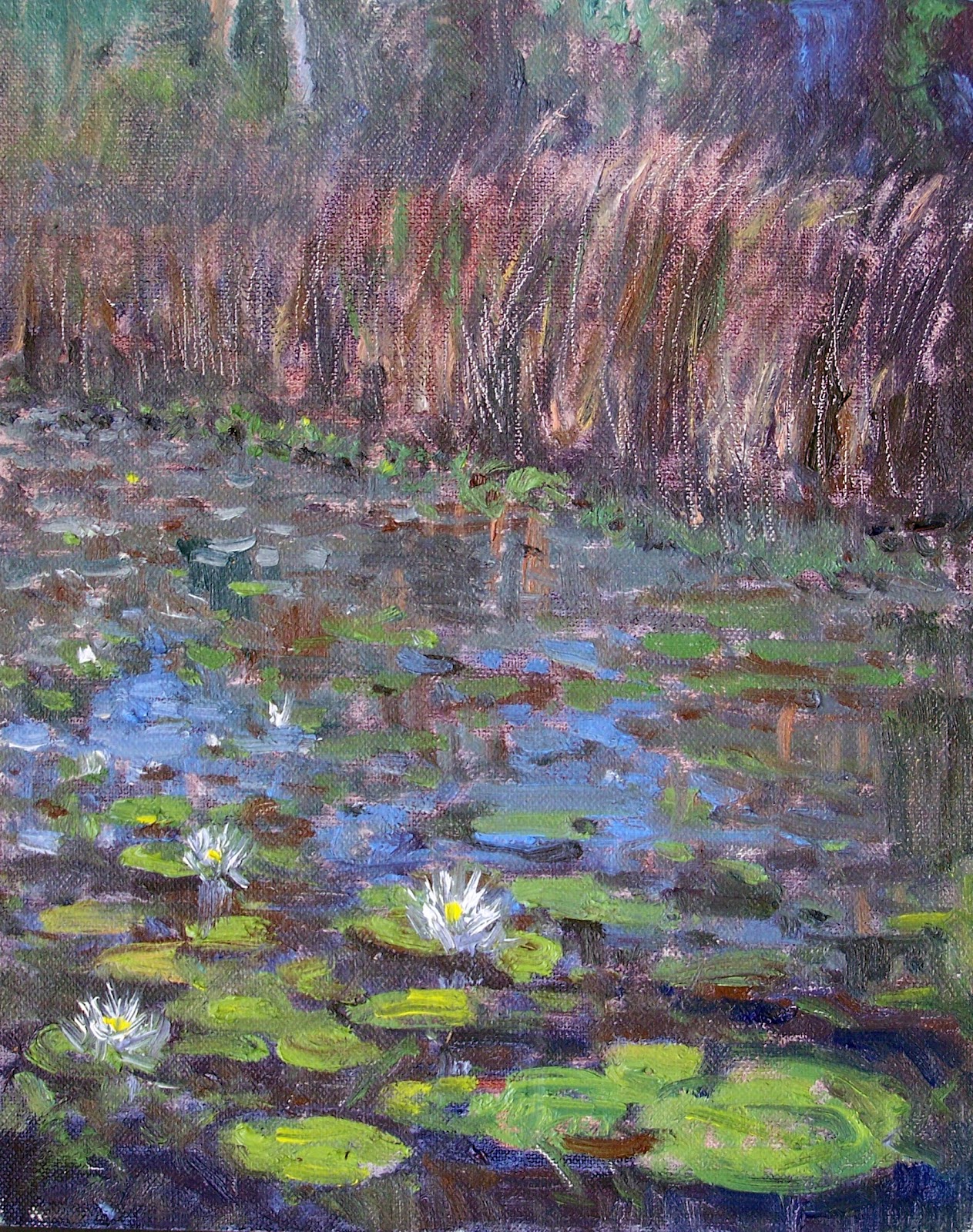
 Florida has seasonal dry spells but for the most part is in great supply of rain. Combined with lower latitude heat and sea level humidity this part of the country is a giant petri dish of biological potential. Bring it and it will grow- whether that means exotic plants or foreign animals. Many mundane species have turned out to be bullies unfettered by restraint found in their source habitats. One plant species that had become a nuisance is the water lily- a familiar theme of one of my painting heroes Claude Monet.
I was able to paint them, however, because even with aggressive herbicide spray they still persist to thrive- as in the lake behind my mother-in-laws house.
The pulse of Florida throbs with the theme of the abundance of life force. Especially the plants and animals associated with the wetlands such as fish, birds and a very major pulse of reptilian and amphibian sorts. The king of this swampy jungle is of course the alligator.
Seething, slimy, wet and noisy abundance from this most primitive of four legged- the amphibians and reptiles. The prolific bird life also adds to the cacophony of noise, embellishing the tapestry of sound spilling out of the waters.

"Dock Lilies" 10x8 oil on linen

When night falls the light fades and although the noises lessen, they persist til dawn. One evening I went out to the floating dock with a powerful flashlight to see what eyeball retinas I could detect. As far as I could see around the edges of the lake were pairs of eyes shining back at me. Some small and close together, others large and far apart and a smattering of varieties in between. An astounding number of eyes- staring at me.
The contrast between Florida and the Rocky Mountains is pretty big. I realized that the theme for the high mountainous part of the world was more about the land itself. Much more active geologically than the coastal lowlands but without the abundance or pure volume of biology that the jungle fosters.
Here the pulse is more about the mountain faces, protruding formations, colorful rocks and the ever present blue skies.
The pulse here is from the very skin of the earth itself.

Great Blue Heron


"Long Pond" 12x9 oil on linen

Friday, March 2, 2012

It's SHOWTIME!

Winter is the time of year to concentrate on studio pieces and to look for show opportunities, at least for me.
Winter on-location painting can be challenging ( ok- cold ) and usually involves shades of white with cool-blue shadows. I am not real excited about snow scenes this winter for some reason.

So I have been visiting larger studio compositions that allow my subject matter to breath a little easier on a larger canvas. I notice that I have a tendency to cram too much content into the plein air pieces and seem to forget the always helpful hint- " less is more."

Another aspect to larger paintings is that they seem to be better candidates for competitive juried shows. Shows are part of the trifecta of selling schemes that also includes commissions and galleries.

I have entered the prestigious Salon International Show for the past decade and have only gotten in twice- until this year where I had two! paintings accepted after a long dry spell.
This show only accepted 434 paintings out of almost 1200 entries submitted from around the world. I am pretty stoked to be in the 2012 show that was judged by Edward Minoff.
The opening for this show will be in San Antonio, Texas on Friday, April 13 at the Greenhouse Gallery. The Show runs until May 2.

"Lemon Cliffs" 18x 24 oil on linen


" Emerald Creek" 16x20 oil on linen


I was also accepted into the Plein Air Artists of Colorado Juried Show for 2012, another highly competetive show. The opening for this show will be Saturday, May 5 in Taos New Mexico at the Wilder Nightengale Gallery.


"Coyote Willow Creek" 9x12 oil on linen

Friday, January 6, 2012

A Special Painting Project

"Evening at the Clark's" oil on linen 18 x 24


Artists are often asked to do specific artwork for a special place, event or of a particular subject matter known in the biz as a commission. It is quite different than someone seeing a painting on a gallery wall and taking it home.

After many years of not having any commissions I've recently completed two.

One of the commissions was by a family to do a portrait of their farm and ranch. They had seen examples of my paintings and were attracted to the way I painted and my imagery.
I went out to their farm and ranch several times. Visiting with them, I was able to determine certain views that they liked such as their house and outbuildings from across their alfalfa field.
They also have a magnificent view of Mount Blanca.
For those of you who aren't familiar with Mount Blanca it is a towering mountain massif of over 14,000 feet and a prominent landmark in this region of the southern Colorado. It could easily be said that one would consciously have to make the effort not to see Mount Blanca while in this area.
I've seen many houses with their directional axes not on the traditional compass points but shifted in such a way that this magnificent mountain is displayed dramatically from many a picture window.

The family also wanted to have a moonrise in view. That definitely helped me to define the time of the day for the piece as well as the amber color scheme of sunsets.

I presented the painting to them upon completion and was thrilled that they thought it was great.

The project was very rewarding for me because I am always trying to connect to the natural world and convey that appreciation to the viewer. In this case the viewers had a very real and established love for this place they call home. We all had a great connection to Mt Blanca and to the beautiful presence of a rising full moon.

Hopefully I can do more of these paintings of collaboration and mutual appreciation for the amazing place where we live.


Saturday, October 1, 2011

My First Plein Air Event or " Outa Bed You Maggots!"


Peak and Lake 12x9 plein air


In August, I went up to Estes Park and hung around some painter friends, some of whom were participating in a plein air event. If you are not familiar with this it goes something like:
There is a time table set up so you bring your panels or canvases to be stamped or authenticated. You then paint on these canvases up until the deadline to turn in your finished pieces. This timeline is variable and can be a couple of weeks or a couple of days.
Athough you may paint a lot of pieces the trick is to pick your best and turn those in. There is usually a limit to how many you may enter anyway. There is a guest judge who picks the best paintings for awards. Of course if the judge picks one of your paintings for an award that indicates an insightful, discriminating expert.
I decided to enter an event in Salida several weeks after the Estes Park event called the Colorado Mountian Plein Air Festival after encouragement from the usual suspects- Sue McCullough and Coni Grant. We painted together for several days.
The underlying theme for these types of events is an opportunity for intense and focused painting for days on end. If you succumb to the pressure ( either self-imposed or peer pressure)it can resemble boot camp. Especially when some painters insist on capturing "alpenglow" -that colorful event when the peaks are lit up by the rosy light of morning. The obvious flaw for me is the time of day- first light hits the peaks early, early morning- or get up in the dark to be at the right place at sunrise.
Alpenglow can also occur at ---- sunset. Unfortunately the sunset scenario is often prone to be clouded up and doesn't afford the same features that are lit up in the morning. So I guess it was worth getting up to see the morning spectacle.
Can't say much for the painting.

We tried to get at least 2 paintings a day. One in the early morning and one in the late afternoon. Midday, when the light is flat, is best used for eating and meditation- ok napping. One day I got three paintings - a personal record! The last one of that day recieved an award even.
Sue, Coni and I all got awards at this show.


Represent!


Here is a selection of paintings from my plein air adventures.


The Water Sperpent 12x 9 plein air Sponsor Award -Colorado Mountain PleinAir Festival


Morning on the Bend 12x16 plein air


Ridgeline 6 x 12 plein air

Friday, August 19, 2011

Flowers and Fur


The Hollyhocks in my Front Yard

Hollyhocks seem to be a very popular southwestern subject for painting. You can probably enter any gallery in Santa Fe or Taos this time of year and find at least one hollyhock painting. Usually you see the flowers juxtaposed against some sort of adobe structure.

In a way the Southwest seems to have claimed the hollyhock as its native symbol.

The recent post by my painting buddy Sue McCullough of a hollyhock painting started me to think about what is really going on with these flowers. I should also mention that I have raised hollyhocks in our front yard for several decades. As I come in and out of my driveway I am treated with displays of these colorful flowers several times a day.

My research reveals that the hollyhock originally came from India and China. It was imported to England about 400 years ago and was brought over with the colonials into New England. From there it spread its way out to the garden's of New Mexico- and into my front yard. I am curious to know if these plants took a different route ( Spain to Mexico?) If any one knows I would be grateful to hear.

The Chinese used the hollyhock flowers for their medicinal qualities as well as eating the fresh blooms. In New England the dried flowers were used as a soothing tea, especially by women. It also has diuretic qualities. I would like to find out if the curanderas of the Southwest also used to hollyhock as an herb.

Hollyhocks lend themselves to my own brand of green -thumbery ( lazy gardening.) I essentially gave over a section of my yard to them and they reseed themselves every year. They are a biennial which means they grow for two years before dying. The second year usually produces more robust plants.


In the late fall, winter or early spring I help the process by stripping and crushing the dried pods and let them scatter where they will. It is always a pleasant surprise to see where they sprout up when the following spring arrives.


This year is unusual in that I was able to actually take advantage of my front yard spectacle with a plein air painting session.


Our two cats were very curious when I set up my french easel.
The yellow long -haired, Leon, decided to pose for me and I obliged him in the painting shown.


" Around the Front" 12x9 plein air oil


Friday, August 12, 2011

Water


One of my painting buddies, Coni Grant, called me up and wondered if I had finished the piece that I had started on a recent outing we had in the Zapata Creek area. I told her I thought it was finished-- so she encouraged me to post it on the blog- because she was going to post her piece on hers and refer readers to look at mine. So here tis...
Froth and Tumble, 12x9


You can check Coni's blog at http://www.pleinview.blogspot.com/


I also recently spruced up a piece we did on a paint out near Taos in May. This was a pond that sits below Kevin MacPherson's place.

Mac's Pond, 12x9


Many of you have noticed that I feature water in my paintings- more often than not. I love to paint water. It affords me the chance to bounce the colors around in a piece and also get fudgy with my brushwork.


I also live in the arid west and maybe I'm just thirsty?


Beaverland, 12x9